21. Aquarium extreme ecosystem: deep-sea trenches
Wednesday, January 14, 2009
5 Weeks Pregnant Open Cervix

.
THE OCEAN DEEP UNKNOWN

Angela heaven? Nooo!, Deep-sea creatures
seek life on other worlds and forget that our planet still has large areas to discover. In the deep sea abyssal pits covering 80% of the ocean has been explored and only 1% of these depths.

© Research Harbor Branch Oceanographic Institute
We're really talking about an ecosystem could well belong to another planet, since it has little to do with what we know. A world of eternal darkness without the sun, half submerged in water devoid of nutrients, the temperature between 0 º - 4 º C and ambient pressure unthinkable x 1 ton cubic cm. Despite these impossible conditions, there is life.

© Research Harbor Branch Oceanographic Institute
The existence of minimal organic matter produced by bacteria that are maintaining biomass through chemosynthesis (cover your needs carbon at the expense of bicarbonate ion, oxidizing ammonia, hydrogen, nitrite, methane or inorganic substances).
Because of this lack of food, has developed a balance based on the absolute predation between creatures and the arrival of animals or dead plants in the upper layers that fall as a blessing from heaven (allochthonous food, ie source different from the living environment).
creatures of the darkness sentences are extremely long-lived and slow live saving energy, including the immense silence and immobility of unguarded current environment. It's the closest thing to live in intergalactic space. During endless hours
remain fixed as statues, and just before the need to flee, eat or play, activate their muscles gelatinous to lazily move without harmony or balance.
Because of this lack of food, has developed a balance based on the absolute predation between creatures and the arrival of animals or dead plants in the upper layers that fall as a blessing from heaven (allochthonous food, ie source different from the living environment).
creatures of the darkness sentences are extremely long-lived and slow live saving energy, including the immense silence and immobility of unguarded current environment. It's the closest thing to live in intergalactic space. During endless hours
remain fixed as statues, and just before the need to flee, eat or play, activate their muscles gelatinous to lazily move without harmony or balance.

living things are little studied. With every dive Expeditionary are discovered ten new species. Some creatures have evolved as spectacular light through bioluminescence, which is discovering what is served, or to hunt as a trap to attract prey, or to find couples of the same species.

soil reaches a depth of up to 11,000 km tiny brightly colored roving bodies dragged seeking shelter and food awaited.
not effected by high pressure, are sponges with open cavities where water can stay here in large communities. His fate is that they are a food prized by other living beings. There is a type of sponge that looks like spun glass prisms, thanks to its textured woven silica fibers.
mean abyssal pits still a mystery, as scientists estimate that remains to be discovered more than 95% of the species that live there.
not effected by high pressure, are sponges with open cavities where water can stay here in large communities. His fate is that they are a food prized by other living beings. There is a type of sponge that looks like spun glass prisms, thanks to its textured woven silica fibers.
mean abyssal pits still a mystery, as scientists estimate that remains to be discovered more than 95% of the species that live there.

© Research STEVEN HADDOCK - MBARI
creation of an aquarium ABYSSAL
Can abyssal aquarium? This question I have made several people and it is difficult to answer with scientific rigor. The human being is able to manage to finally achieve his goal and in this case, if we play the same conditions as in the deep sea as it would clearly be viable. Not so much financially.
What are these conditions?
1. The tank should be sturdy enough to withstand water under a pressure of 1 ton x cm ³. Precisely bathyscaphes or submarines entering these depths support these pressures. Its construction is usually done with concrete and titanium alloys. Thus, we should build something like a submarine with windows but with a reverse order to hold water inside.
Can abyssal aquarium? This question I have made several people and it is difficult to answer with scientific rigor. The human being is able to manage to finally achieve his goal and in this case, if we play the same conditions as in the deep sea as it would clearly be viable. Not so much financially.
What are these conditions?
1. The tank should be sturdy enough to withstand water under a pressure of 1 ton x cm ³. Precisely bathyscaphes or submarines entering these depths support these pressures. Its construction is usually done with concrete and titanium alloys. Thus, we should build something like a submarine with windows but with a reverse order to hold water inside.

abyssal aquarium design front view

abyssal aquarium design rear view
2. For get this constant pressure in the water, they should design a powered hydraulic pistons to push water into the tank. A mechanism must be precise and powerful that can be anchored to deliver the result we want: 1 ton x cm ³.
3. must have a good filtering system, although the water to be poor in nutrients and so cold in theory kept clean. The conditions of the deep trenches are similar to those of bottled water in the sense that it moves in the absence of currents. Anyway, it would be interesting to experiment with a kind of sump or space where you can enter chemosynthetic autotrophic bacteria (autoproducer and consumers of nutrients) and heterotrophic (feeding on dung and carrion from the abyss).
4. Keep chilled water in a constant temperature between 1 º and 4 º C.
5. occasion not to stress the animals are kept, it is important that the tank was hidden opaque to light, and as much, has windows to see inside. In the deep darkness reigns, except in the very animals that produce bioluminescence. The internally illuminated by fiber optics would be most appropriate because of the inordinate pressure on the lights implode. With fiber optic light source can be calculated from the outside, adjusting it to the best conditions.
6. most interesting species to keep are the most striking: those that produce light. In theory, we should keep only one predator species by nature. Few creatures are known to occupy large areas. On the other hand, their status as food economy and extremely low production of excretions would make easier to maintain.
3. must have a good filtering system, although the water to be poor in nutrients and so cold in theory kept clean. The conditions of the deep trenches are similar to those of bottled water in the sense that it moves in the absence of currents. Anyway, it would be interesting to experiment with a kind of sump or space where you can enter chemosynthetic autotrophic bacteria (autoproducer and consumers of nutrients) and heterotrophic (feeding on dung and carrion from the abyss).
4. Keep chilled water in a constant temperature between 1 º and 4 º C.
5. occasion not to stress the animals are kept, it is important that the tank was hidden opaque to light, and as much, has windows to see inside. In the deep darkness reigns, except in the very animals that produce bioluminescence. The internally illuminated by fiber optics would be most appropriate because of the inordinate pressure on the lights implode. With fiber optic light source can be calculated from the outside, adjusting it to the best conditions.
6. most interesting species to keep are the most striking: those that produce light. In theory, we should keep only one predator species by nature. Few creatures are known to occupy large areas. On the other hand, their status as food economy and extremely low production of excretions would make easier to maintain.


extreme ecosystems These experiments offer 2 very important reasons to take Term:
a. means a step forward in studying the exotic and unknown deep-sea species behavior in these extreme conditions for us, under continuous observation.
b. help us better understand the different possibilities in life forms, is essential to investigate the possibility of alien life in distant worlds inhabited (exobiology).
schemes were designed to understand how this tank should be unfathomable.
NOTE: As these issues are complex and require much imagination, other questions assail me basic the introduction or removal of these creatures in the aquarium. Should always be handled under pressure. The only thing that comes to mind is captured with resistant sealed containers that are open systems, lock and access as the hatch of spacecraft or submarines. Animals being so slow, fishing is supposed to be simple.
For more information on this exciting topic I recommend visiting the following websites:
© PHOTOS Creatures collected by the intrepid journalist Claire Nouvier living in deep-sea trenches: The Deep
More interesting information :
Http://biotech.bioetica.org/ap2.htm
http://ec.europa.eu/research/rtdinfsup/es/depth.htm
http://www.elmundo.es/elmundo / 2005/11/30/ciencia/1133344399.html
http://es.wikipedia.org/wiki/Fosa_oce% C3% A1nica
http://mgar.net/mar/fondos.htm

abyssal pits covering 80% of the ocean has been explored and only 1% Notebooks
artificial ecosystem 

Wednesday, February 14, 2007
Ringworm Lie Dormant In Horse
The enigma of the clocks of Muna
Recently, when I went to draw the two clocks of the convent of San Francisco de Oxkutzcab, I spoke with Pbtro. the convent, which had been previously assigned to the Convent of the Assumption of Muna. I said if we would restore the missing two clocks (the direct lift and direct Noon) and Muna watches had drawn a mason for about ten years using marks every hour during certain months of the year made "to understand", so the father told him to stop the work because they felt that the hours were marked wrong.
This confirms my hypothesis that the walls were well targeted but the paths corresponded to a recent intervention. Soon I hope to make some creeks in the plastered surface to see if it remains behind the original paths. I also hope to publish photographs of the sundial of the Convent of San Miguel Archangel of Mani, one of the first of the period of evangelization in the Yucatan.
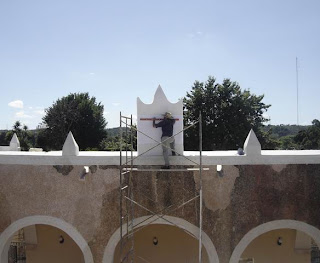
Here are some photos of the layout of the two clocks Oxkutzcab:
 Fig. 1. Stroke of watches to the west and north. Simple paths are marked local solar time.


Recently, when I went to draw the two clocks of the convent of San Francisco de Oxkutzcab, I spoke with Pbtro. the convent, which had been previously assigned to the Convent of the Assumption of Muna. I said if we would restore the missing two clocks (the direct lift and direct Noon) and Muna watches had drawn a mason for about ten years using marks every hour during certain months of the year made "to understand", so the father told him to stop the work because they felt that the hours were marked wrong.
This confirms my hypothesis that the walls were well targeted but the paths corresponded to a recent intervention. Soon I hope to make some creeks in the plastered surface to see if it remains behind the original paths. I also hope to publish photographs of the sundial of the Convent of San Miguel Archangel of Mani, one of the first of the period of evangelization in the Yucatan.
Here are some photos of the layout of the two clocks Oxkutzcab:
Fig. 1. Stroke of watches to the west and north. Simple paths are marked local solar time. Fig. 2. Transfer preparation of carbon paper print paths 
1:1 scale Fig. 3. Clock trace to the west.
Fig. 4. Direct clock trace to the north (after leveling the transfer). 
Fig. 5. Clock End of the line north

Fig. 6. Checking the clock setting (12:45 PM). The gnomons be produced in stainless steel.

Fig. 7. Direct clock setting. 
Fig. 8. Watch live north
paths are too weak to be seen in the distance, but will post photos of them once painted and assembled the gnomon.
Tuesday, January 9, 2007
Most Reliable Pc Supplier Aftercare 2010
Gnomon CURIOUS CASE ... COLONIAL? Solar Watches


The Convent of the Assumption of Muna, Yucatan, dating from the late seventeenth century and its cloister presents a set of four solar quadrants oriented to the four cardinal points. Its construction date is unknown to us, but we assume is contemporary to the time of erection of the convent.
The reason for this note, in addition to highlighting the existence of these plots (of which only one of them "keep" the gnomon) is its peculiar way to mark paths and nomeclatura time since ... none of them is right! We know that in the case of historical quadrants may be slight (or large) discrepancies in the schedule drawn mainly the calculation of the decline of the wall, but this case ... is really special.
 1: Overview of the Cloister of the Convent of the Assumption of Muna, Yucatan, with its four sundials.
1: Overview of the Cloister of the Convent of the Assumption of Muna, Yucatan, with its four sundials. 2: Quadrants to the East and South. Apparently, the paths are correct ...
 Fig. 3. Direct Midi Clock. The nomeclatura time starts at 6 (VI) hours in the left quadrant, up to 12 (XII) hours in the crystal. But when it is not for one in the afternoon ... but the 6 (VI) hours! This is because inexplicably begin numbering the evening hours from 1 to 6, but starting from the right side of the quadrant to the meridian, ie in the opposite direction (?). In this clock, therefore, the decline is marked at one o'clock.
Special mention should be made of the poor design of the gnomon, which is not in limbo the angle corresponding to the colatitude of the place (Muna, Yucatán: 20 ° 29'6 .03 "N 89 ° 42'46 .49" W) but is a simple rod perpendicularly embedded "in the pole" of radiation.

Fig. 4. Direct Watch Levante. Although this type of watches can only make ortho-hour at noon, here the numbering of the time 1 (I) hours at the top to the 6 (VI) hours in the bottom ... and turn around in ascending order until the 12 (XII) hours back to the top of the dial!
also paths schedules, especially those must correspond to the sixth and seventh hours have a similar separation between them.
Direct Watch West has a very similar arrangement with its corresponding towards the east, but the North has direct clock schedules identical to the direct routes to Noon. We
to conjecture:
1 st: The orientation of the four walls is correct, I have not had the opportunity to make exploratory coves sgraffito stucco that could reveal any previous intervention stage, since it is not logical sundials an implementation of well-targeted but poorly targeted.
2: The quality of these graffiti bill is very poor, which suggests that it is a further intervention by a hand made unfit for gnomonic issues.
3: A third conjecture can guess that actually are original paths (remember the ordinances binding on all the monasteries of the Seraphic Order to have sundials in their monasteries) but had to be done "to get by" possibly using or copying similar clocks correctly traced as in the case of the Convent of Mama.
The most likely case of an attempt to recover relatively recently. In fact the original quadrants possibly consisted of stone slabs, which are being lost.
be a restoration of this set of squares, I think we should replace the stone slabs with correct paths (without corrections for length or time zone, to respect the spirit of the time) and before deleting the existing tracks, record carefully the curious case of "gnomonic colonial" present in one of the buildings that make up our architectural heritage.
Subscribe to:
Posts (Atom)